
Straight answers before you book.
Everything students ask us most — costs, the aircraft, the location, and how to start. If your question isn't here, call 715-394-6444 and ask a person.
KSUW · Superior, Wisconsin · 715-394-6444
Cost
How much does it cost to earn a Private Pilot License?
We publish hourly rates rather than one package price, because the total depends on how often you fly. A Cessna 172 is $145–$155 per hour wet and instruction is $85 per hour, paid lesson by lesson. The FAA minimum for a Private Pilot certificate is 40 hours and most people need more — flying consistently is what keeps that number down. Call 715-394-6444 and we will work the figure out with you.
How long does it take to get my license?
Students who fly two or three times a week generally finish a Private Pilot certificate in a matter of months; flying once or twice a month stretches it into a year or more. Frequency is the whole story — long gaps mean re-learning what you already paid to learn. We fly seven days a week so you can keep a rhythm.
Can I finance my flight training?
Yes. Most students here pay as they fly, one lesson at a time, and for those who would rather finance the whole path we work with Stratus Financial, a lender that specializes in flight training. Aviation scholarships through AOPA and EAA are worth applying for as well.
What does financing actually cover?
Financing through a partner like Stratus Financial is generally used for aircraft rental and instruction — the hourly costs that make up most of the bill. Books, a headset, your FAA medical, the written exam fee and the checkride examiner’s fee are usually paid separately, and they are worth budgeting for from the start.
Do I need to finance the whole program up front?
No. Paying as you fly is how most students here do it: you pay for the lesson you just took, at the published hourly rate, and nothing else is owed. Financing the whole program is an option if you want to fly without gaps — not a requirement.
Getting started
Do I need any previous experience to start?
No. Most people who walk in here have never touched an airplane, and nothing about a first lesson assumes you have. A Discovery Flight is built for exactly that: you take the controls with a certified flight instructor beside you the whole time.
What is a Discovery Flight?
A Discovery Flight is a real introductory lesson, not a scenic ride — you sit at the controls of one of our Cessna 172s with an FAA-certified flight instructor next to you. It is $125, and the time you log counts toward your pilot license.
Is it safe?
Training aircraft are built for exactly this. Our Cessna 172s and the Piper Seneca have dual controls, so your instructor can take over instantly at any moment, and every airplane is maintained in our own hangar here on the field rather than shipped out to a shop. We also cancel for weather without argument — a lesson is easy to move, and no instructor here will fly you into conditions they aren’t comfortable in.
How do I get started?
Call us at 715-394-6444, or send the form on this site and we will call you back. From there the first step is a Discovery Flight: $125, one flight, one instructor, and time that counts toward your license.
Can friends or family come and watch?
Yes — bring them. Family and friends are welcome to come along and wait inside, and most first-timers want somebody there for the landing. Let us know how many are coming, and check with us on arrival about where they can stand, since ramp access depends on what is happening on the field that day.
The airplanes
What aircraft will I train in?
A Cessna 172. We have four of them, from a 160 HP VFR trainer up to a 180 HP airplane with dual Garmin G5s and a GTN 375, plus an IFR-certified 172 with a Garmin G500. Multi-engine training happens in our 1983 Piper Seneca III.
How old are the airplanes, and how are they maintained?
Maintenance is done in house, in our own hangar here on the field, on the inspection schedule every training aircraft follows — a 100-hour inspection for aircraft flown for hire, and an annual inspection every twelve months. Keeping that work here rather than sending airframes away is the reason our aircraft downtime stays short.
How many aircraft do you have, and will I always get one?
Five: four Cessna 172s and a Piper Seneca III, plus a PFC DCX Max training device for procedures. It is a small fleet for a small school, lessons are booked ahead, and in-house maintenance is what keeps the airplane you reserved from disappearing to a shop for a month.
Will I train in the same airplane every lesson?
Usually early on, and deliberately not forever. Consistency helps at the start, so most students spend their first lessons in one airplane; later we move you between our 172s on purpose, because a pilot who has only ever flown one panel isn’t really finished.
Do the aircraft have glass cockpits or steam gauges?
Both, on purpose. N616SK has dual Garmin G5s and a Garmin GTN 375, and N784BG is IFR certified with a Garmin G500 PFD/MFD and a 430W; N5490H and N737DV are conventional steam-gauge VFR trainers. Learning across both makes you a considerably more adaptable pilot.
Training & the airfield
Do I need a medical certificate?
Yes — for a Private Pilot certificate you will need at least a third-class FAA medical certificate before you fly solo. You do not need one for your first lesson or your Discovery Flight. Ask us and we will point you toward an Aviation Medical Examiner near the Twin Ports.
Are you a Part 61 or Part 141 school?
Part 61. That means your training is built around your schedule and your progress rather than a fixed syllabus timetable — which is what most of our students, people with jobs and families and commutes, actually need.
Where are you located?
At 4804 Hammond Ave, Superior, WI 54880 — on the field at KSUW in Superior, Wisconsin, about fifteen minutes from Duluth, Minnesota.
Can flight training be a career?
Yes, and it is the path a lot of our students are on. We train Private, Instrument, Commercial and Multi-Engine, plus CFI, CFII and MEI — the ratings that let you be paid to fly and to build hours by instructing. Our owner still flies as a contract pilot for companies in the area, so the route from this field to a paid seat is not theoretical.
Is there parking, and where do I go on my first visit?
Yes, there is parking on site at 4804 Hammond Ave. Come to the main building and in the front door — somebody at the desk will be expecting you and your instructor will meet you there. You never have to find your own way out onto the ramp.
Which airport do you fly out of?
KSUW, the airport in Superior, Wisconsin, at 4804 Hammond Ave. It is roughly fifteen minutes from Duluth, Minnesota, and it is a quiet field — which means less time holding short and more time actually flying.
Take your time with it.
There is no rush and no wrong question. Work through the list above — then call, and a person will answer the rest.
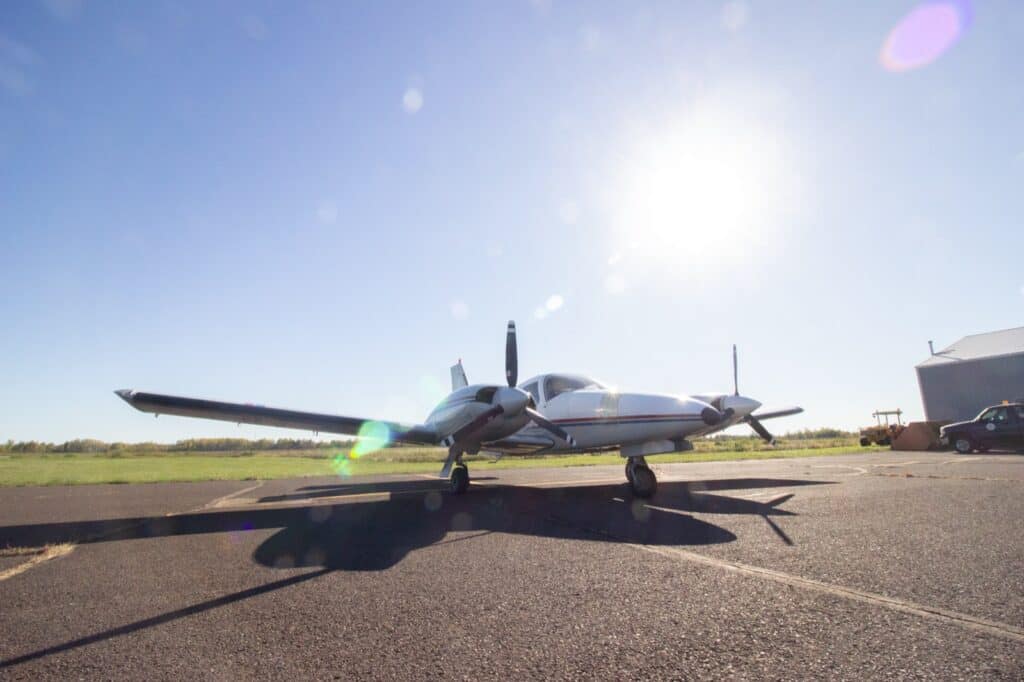 Superior Flying · Richard I. Bong Airport
 Still have a question?
Reach out through the contact page — or just call. We'll help you determine the best next step.
Serving Duluth · Hermantown · Cloquet · Ashland